

In the morning, there are many leashed dogs waiting outside the door. They are filled with energy but their owners have no time to keep up with it. Every busy pet-parent must have someone who they can rely on. And that person could be you.
If you are thinking of replacing a long day at a desk with fresh air, flexible income, and wagging tails, then it may be the best move you have ever made in learning how to start a dog walking business. Each year, Americans invest billions of dollars into their pets, so this is not a side business, but a rapidly developing business with actual prospects.
Through this blog, you will know precisely what you must do to make your love for dogs a stable source of income. Whether it is creating your initial customer base or graduating to a whole pet-care establishment, this is your blueprint to a profession that not only pays but also rewards that feel good moments during your career.
What Do Dog Walking Businesses Entail? Core Services Explained
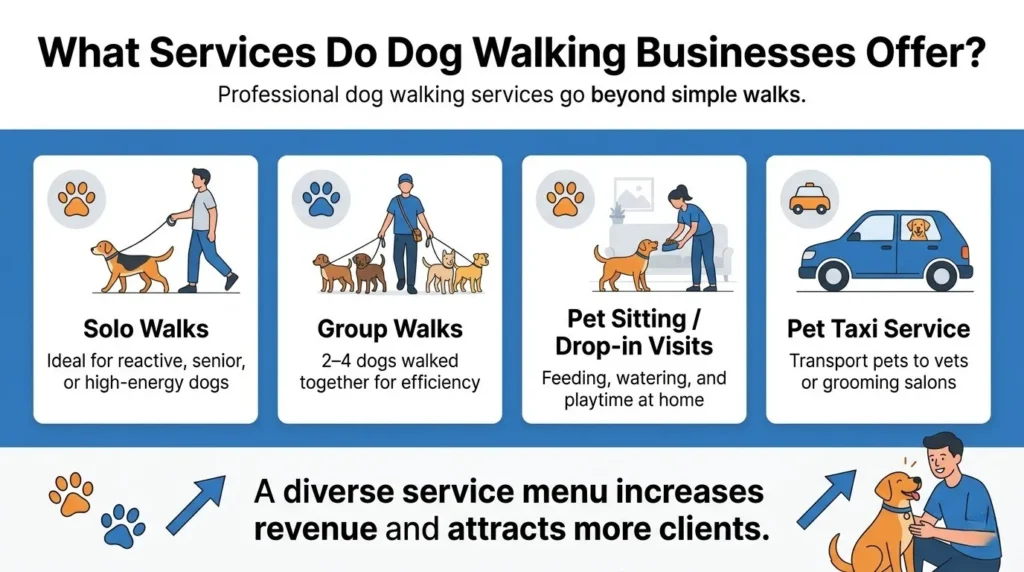
A professional dog walking business provides the dogs with some exercise, company and bathroom breaks in the absence of their owners. It is a registered, insured company unlike casual neighborhood walkers that do not have contracts.
In order to earn more money, provide the following specialized dog walking services:
- solo walks: these are mainly for reactive/ seniors/ high-energy dogs
- Group Walks: 2-4 dog walks together, hence these are profitable and require excellent pack-leading abilities.
- Pet Sitting / Drop-in: During the time that owners are away overnight, they visit their homes to feed, water, and play with their pets.
- Pet Taxi: hassle-free transporting of pets to and from the veterinary or grooming salon.
The process of defining your service menu is only the first step and the real job of establishing your business is actually making it legal and functional.
Step-by-Step Guide on How to Start a Dog Walking Business
Starting a pet care business requires more than a leash and shoes. The following are 10 key steps on how to establish a dog walking business:
1. Conduct Market Research
You must understand how many people in your city or neighborhood desire dog-walking services before you launch.
- Define Competition: Search local walkers on Google, Rover, and Wag. Be aware of their areas of service, prices and what they may not have.
- Find Your Target Audience: Determine whether you want to sell to busy office workers or older individuals who need assistance exercising high-energy dogs.
- Spot the Gaps: Find a niche. There are possibly a limited number of walkers in your locality who specialize in large dogs, puppy potty training or walks with reactive dogs.
2. Create a Business Plan
Your roadmap is a good business plan. It prevents you of the expensive errors and makes you keep track of it.
- Executive Summary: Provide an overview of your purpose and market.
- Financial Projections: Determine the cost of starting the business and determine how many walks it will require each week to reach the revenue objectives.
- Marketing Strategy: Decide how and where you will acquire your first 10 clients.
3. Follow the rules governing Dog Walkers
Although the US has no such thing as a national dog-walking license, location regulations determine the legal manner in which you can operate in the country.
- Pack Walking Limits: The number of dogs that one walks is restricted to mostly 4-6 dogs in many cities and parks.
- Leash Laws: it is mandatory that in public places the leash must not be longer than 6 feet.
- Waste Disposal Fines: Failing to remove the dog waste would result in a huge fine.
4. Define and Price Your Services
Do not attempt to do everything to everybody. Be clear on what you are offering and give competitive rates that match your value.
- Make a Service Menu: Have a combination of 15 minutes puppy drop-ins, daily 30 minute walks, and 60-minute hikes.
- Set up Add-On Fees: Add more fees to medicine, walks on weekends or numerous dogs in a household.
- Research Local Pricing: In most areas on an average the 30-minute walk is between $20 and $30. It may vary depending on the price of your city.
5. Select Business Name and Legal Structure.
The appropriate structure will ensure that your personal assets are insured in case of failure.
- Choose an Easy Name to Remember: It must have a name easy to memorize and a name indicating your city or service such as Metro Paws Dog Walking.
- Create LLC: a limited liability Company also isolates your personal finances and the business, and it is an intelligent option among the walkers.
- Register at the State: Have your name and LLC paperwork registered with your Secretary of State.
6. Obtain Permits and Licenses
Legal operation gains trust and ensures that you remain on the good side of taxes.
- Obtain an EIN: To open a business bank account, apply to the IRS to receive a free Employer Identification Number.
- Local Business License: request city hall or county clerk to issue a general municipal business license.
- Zoning Permits: In case you want to keep dogs at home, you should check on the zoning regulations on residential properties.
7. Set Up Your Operations
Your day to day work is stress-free due to efficiency and security. Establish mechanisms prior to picking up your first client.
- Buy Pet Sitter Insurance: get liability insurance and bonding to pay for breakages, loss of keys and Vet Emergencies.
- Use Scheduling Software: Use an application to schedule, track and create invoices, such as Time to Pet or Pet Sitters Plus.
- Draft Client Contracts: have every client sign a Service Contract, and a Veterinary Release Form.
8. Get Dog Walking Essentials
Do not rely on the cheap or defective equipment of a client. A professional carries his or her own equipment in case of need.
- The Essentials: keep plenty of biodegradable poop bags, a wound-up canine first-aid kit and leashes (heavy-duty and 4 to 6 feet in length).
- Treats and Hydration: carry high worthy products in the form of treats and a foldable water bowl on hot days.
- Walker Comfort: Choose waterproof shoes and a hands-free belt.
9. Build Your Client Base
The quickest method of ensuring that your schedule is full is to use a local marketing strategy.
- Claim Your Google Business Profile: You can be found on Google Maps when people in your area search for a dog walker near me.
- Network with Pet Pros: Distribute flyers at dog boarding shops, groomers and vendor clinics.
- Use Social Media: Share on local Facebook communities and Nextdoor to tell the world about your new business.
10. Launch, Collect Reviews and Scale
Last but not least, begin to walk, serve to the limit, and grow with initial success.
- Over-Communicate: Photos and GPS paths at the end of each walk to clients. They pay because of the peace of mind that they get.
- Find 5-Star Reviews: Ask satisfied clients to comment on your Google profile. Social proof is a sales tool.
- Plan to Growth: When you are full of a solo schedule, plan to hire contractors or employees to grow and increase revenue.
Now that you have a legally registered company and have the necessary equipment, the next thing is to get pet owners to employ you.
If you’re exploring service-based ventures, both a catering business and starting a bookkeeping business offer great opportunities. While bookkeeping provides steady demand and flexibility, a catering business stands out with its creative freedom, vibrant events, and rewarding customer interactions that make the work truly enjoyable.
What Is the Cost of Starting a Dog Walking Business?
The low entry barrier is one of the most appealing features of a dog walking business. You do not have to rent commercial space or to purchase costly inventory, as is the case with a retail store.
The approximate initial cost of starting a Dog Walking Business is shown below:
| Startup Expense Category | Estimated Cost (USD) | Description |
| LLC Registration | $50 – $200 | Extremely depends on state |
| Business Insurance & Bonding | $150 – $350 | Yearly charge on regular pet care liability insurance. |
| Pet CPR/ First Aid/ Certifications. | $50 – $100 | One time charge of training course (e.g., through Red Cross). |
| Basic Equipment & Supplies | $100 – $150 | Two additional leashes, poop bags, treats, first aid kit and walking shoes. |
| Marketing & Website setup | $100 – $300 | Domain name, simple hosting of the webpage and printing of the local flyers. |
| Scheduling Software (optional) | $15 – $35 / month | Applications such as Time To Pet to schedule an appointment and invoices. |
| Total Estimated Startup Cost. | $465 – $1,135 | One of the cheapest ventures in comparison with the rest of the small business. |
With these initial costs in mind, you can have a much easier time predicting your possible income and eventual financial success.
Profit Margin, Revenue, and ROI of a Dog Walking Business
A dog walking business has an incredibly fast payback period due to remarkably low startup costs.
- High Revenue Potential:
If you walk 8 dogs on a daily basis with a charge of 25 dollars each walk, you will generate an average of 200 dollars a day. It is approximately $52000 a year in a 5-day week. In case you do group walks (e.g. 3 dogs costing $20 each) you can hit more than $70,000/year.
- Exceptional Profit Margins:
Margins normally range between 70-85%. Close to being nothing because you sell your time, not inventory:
- gas and vehicle maintenance
- poop bags and treats
- annual pet sitters insurance coverage.
- self‑employment taxes
- Scaling Your Operations: You can expand by hiring independent contractors or employees to cover more routes when you are a solo walker.
Although the financial figure is appealing, you should also take into account the real daily life aspects of the job.
Top Benefits and Challenges of Starting a Dog Walking Company
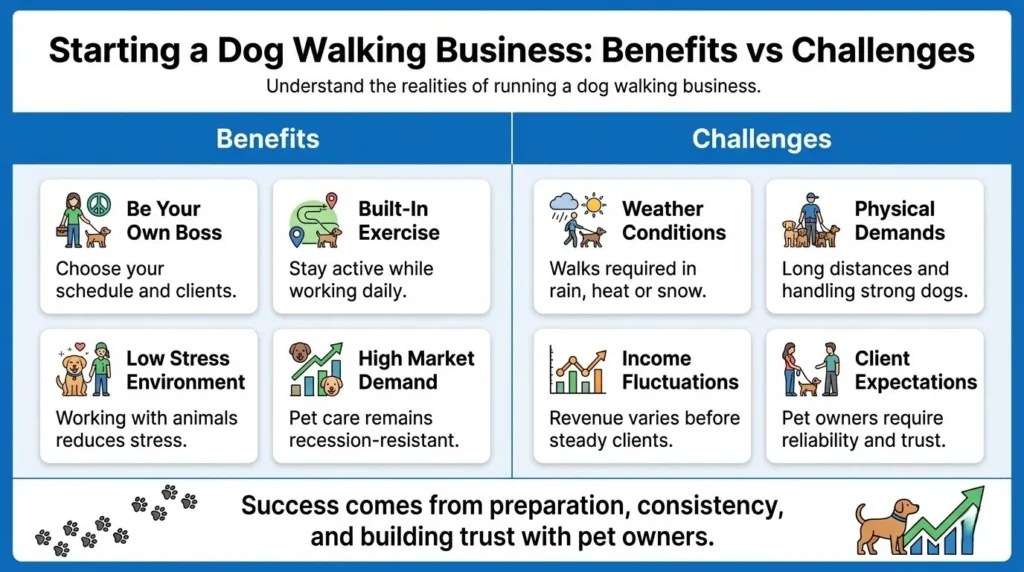
In any business, there are ups and downs of the process. You have to weigh the advantages and disadvantages.
The Benefits
- Be Your Own Boss: You choose your working hours, the customers to work with and develop the business in your style.
- Integrated Exercise: You actually receive money to exercise. You are moving between 5 and 10 miles per day, which keeps you fit and off a desk.
- Low stress work environment: Being in the company of animals indeed works wonders in alleviating stress and making a person feel better.
- High Demand: Pet care business remains in high demand even during poor economic periods. Humans treat their dogs like children and will continue taking care of them regardless.
The Challenges
- Unpredictable Weather: You need to be prepared to walk through rain, sleet, snow and extremely hot weather. Dogs require bathroom breaks hourly regardless of weather conditions.
- Physical Toll: Walking a long distance, dragging huge dogs, and standing the entire day may be tiresome.
- Unpredictable Revenue at the beginning: Before establishing a regular client base, there will be a rise and fall in earnings.
- Handling of Client Expectations: Dog owners are extremely protective and demanding, thus requiring patience
Conclusion
The idea of opening a dog walking business could be exhilarating and encouraging. This blog included an overview of what a dog walking service entails, 10 key steps to launch it legally, and a cost and revenue analysis. We also examined benefits and issues in the real world.
You can build a profitable and rewarding business by understanding how to start a dog walking business, along with proper market research, effective insurance, excellent communication, and trustworthy care.
FAQs
1. Do I Require A Special License In Order To Walk The Dogs?
In most cities within the US, there is no specific dog walking license that you will be required to have, although you will most probably need a business license to operate. Always check local rules.
2. How To Obtain The Experience Of Dog Walking?
Volunteer in a local animal shelter to know more about respective breeds and temperaments. Walking dogs of friends or family can also be used to build a testimonial base.
3. Is It Best To Use An App Such As Rover Or Should I Start My Own Business?
Some applications, such as Rover and Wag, allow you to get 20 percent of your earnings since they direct you to clients at an early stage. Being self-employed with insurance provides you a chance to retain 100% of your income, as well as building your own brand.
4. What Will Happen To The Dog In Case It Becomes Sick Or It Is Injured?
That is why you have to insure yourself with pet sitter liability insurance and the emergency vet release form. It is always good to be able to take the dog to the vet in the event of an emergency, inform the owner immediately and leave the insurance to take care of the claim.