
Online shopping has transformed the delivery landscape. Once a customer orders a product by clicking on “buy now,” a very large logistics mechanism begins to transport that product out of the warehouse to the door. The star of this fast system is the quiet box truck.
Box trucks are quite critical to local freight. They provide the final delivery, transport retail and relocate products between warehouses. With the rise of online shopping, firms seek reliable local courier service providers to transport items quickly and efficiently.
This is a huge opportunity for drivers and owners. Compared with large trucks, establishing a box truck business is less costly and can provide stable contracts and opportunities for expansion.
Purchasing a truck is not enough. This blog provides the details on how to start a Box Truck Business in 2026 and includes the business model, start-up capital, legal regulations, and key steps that need to be undertaken to ensure profitability.
What is a Box Truck Business?
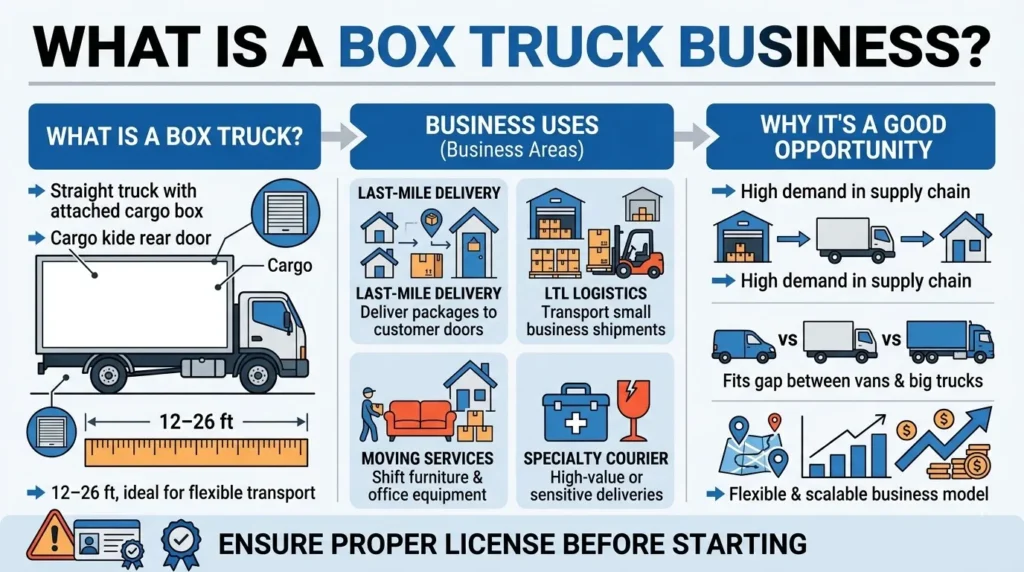
In order to operate a successful transport company, you must be familiar with your gear and work mode. A box truck company specializes in a straight or a cube truck, in which the cab and the cargo box are mounted atop the same chassis. These smaller trucks, unlike big 18-wheelers, are equipped with roll-up rear doors that are excellent for loading fast at docks and in residential areas.
Their size (typically 12-26 feet) allows box truck owners to pack a highly lucrative niche in the U.S. supply chain. They primarily provide the following areas:
- Last-mile delivery: the delivery of online purchases between the distribution centers and the doors of customers (e.g., Amazon, Wayfair).
- LTL logistics: transportation of small, fast business-to-business pallets that do not require a 53-foot truck.
- Moving operations: the transportation of office equipment or domestic furniture.
- Specialty courier: delivery of high-value items e.g. medical equipment, automotive parts of high-value items e.g., medical equipment, automotive parts, or exhibition furnishings. or exhibition furnishings.
Box trucks fall somewhere between little vans and heavy semis, and enable you to bridge the large market demand. However, you should not purchase a truck unless you are certain that you can legally drive it.
Do You Need a CDL for a Box Truck?
One of the biggest problems with starting a box truck business is finding the appropriate license. CDL regulations in the U.S. are based on the FMCSA and do not revolve around the length of your truck, but rather its gross weight.
Here is the exact breakdown:
- Non-CDL box trucks (26,000 lbs or less): you may drive with a standard Class D driver’s license, as many 24- or 26-foot box trucks are. This will allow you to start a successful freight business quickly without having to complete months of CDL training.
- CDL box trucks (26,001 or over): Are you over that weight, then you require a class B CDL. No driving without it may result in hefty fines, being deprived of your truck and right to operate.
Beginner Pro-tip: Buy a non-box truck on CDL. It also reduces entry costs and insurance costs, and facilitates future driver hiring.
Next, we will examine why this niche attracts so many new business owners.
Why Start a Box Truck Business?
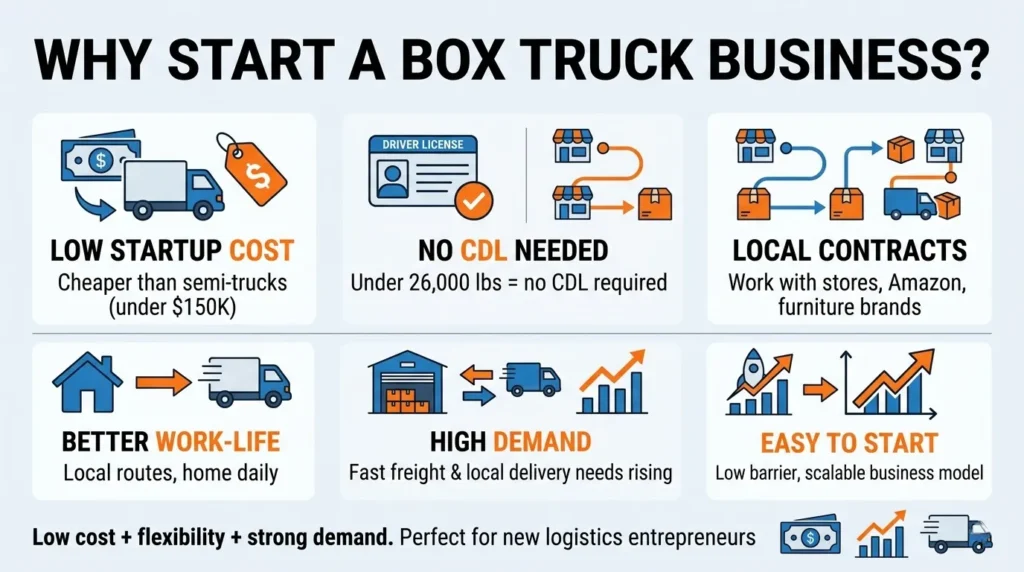
Trucking is huge, but box trucking is able to offer special advantages that long-haul freight can not. The following are the advantages to help decide whether you should purchase a box truck or a semi.
- Reduced start-up expenses: A used box truck is much cheaper than a new semi-truck, which may cost more than 150,000.
- No CDL often required: When your truck is less than 26,000 lbs, you do not have to attend CDL school and pay its price.
- Stable local transportation: Box trucks can dominate local delivery; therefore, you may get contracts with any local store, Amazon Relay, or furniture stores.
- Improved work-life balance: You will not be forced to spend weeks sleeping in truck stops. Your destinations are local, so you can sleep in your beds for most of the night.
- Demand for fast freight: Makers and warehouses often require rapid transport between states, which is ideal for straight trucks.
The advantages are obvious: low cost, ease of start-up, and improved quality of life. But how do you begin? We shall describe the operational and legal procedures.
Suggested Read
Starting a Box Truck Business: A Step-by-Step Guide
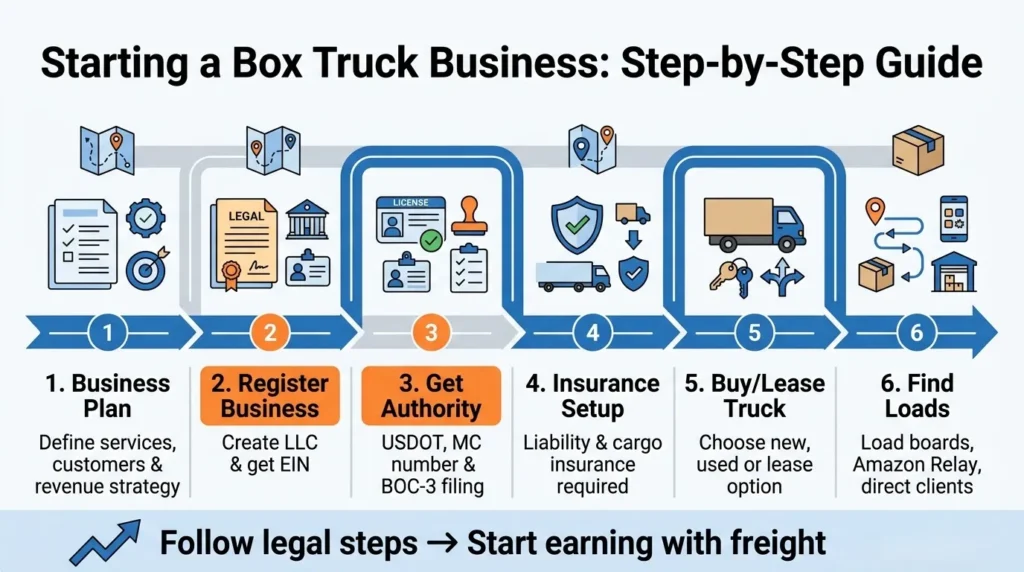
To become a real, road-ready trucking company, you have to adhere to all rules of the U.S. federal and state governments. These measures will help you develop a legal, safe, and profitable business.
Step 1: Creation of an Intensive Box Truck Business Plan
Any successful trucking company begins with a solid plan. List the contents of what you plan to carry, such as medical supplies, moving items, or business goods. Choose the type of customers you will deal with and determine how much money you would need to operate the business. You also need to identify how you will reach clients without engaging brokers, with the goal of securing high-paying contracts.
Step 2: Form Your Legal Body
Business registration helps keep your money safe. Most owners form an LLC in their state. Then, obtain a no-charge EIN on the IRS site. Business registration helps keep your money safe. Most owners form an LLC in their state. Then, obtain a no charge EIN on the IRS site.
Step 3: To obtain the FMCSA Operating Authority
This step is the most important. You require:
- USDOT number: The number tracked by the DOT for your safety record.
- MC number: You need to have it when you intend to transport federal commodities across states.
- BOC-3 filing: Name of a legal agent in every state where you have to operate, in the event of any legal issues.
Step 4: Commercial Truck Insurance purchase
Without insurance, you can not get an MC number. In the case of a box truck, the majority of the companies require the auto liability of $1,000,000 and the cargo insurance of at least $100,000 to be able to use load boards.
Step 5: Acquire Your Box Truck
Decide whether to purchase a new truck, purchase a used truck, or lease one. Leasing is cheaper in the short term, but it reduces monthly profits. Selling used through websites such as Ryder or Penske is a popular option among new sellers. Ensure the truck is equipped with a liftgate and a pallet jack, which are necessary for high-paying jobs.
Step 6: Locate Box Truck loads and Freight Contracts
You can begin generating money when your authority is established. Find freight:
- With the help of load boards, they include DAT Power, Truckstop.com, and 123Loadboard, which are standards in the industry.
- Joining dispatch programs: Amazon Relay will be a good place to start with for 26-foot box trucks.
- Direct pitching: Cold-calling local manufacturing facilities, printing firms, and commercial bakeries, to have direct and middle-man-free routes.
After sorting legal and operational systems, let’s examine the amount of money required. What is the amount of cash you actually require?
Cost to Establish a Box Truck Business: Budget Breakdown
The biggest error new owner-operators make is underestimating the hidden costs of the trucking industry. It does not require millions, but an operating reserve. The following is a practical estimation of costs incurred when launching in the US market.
| Expense Category | Estimated Cost Range (USD) | Frequency | Description |
| Business Formation (LLC, EIN) | $100 to $800 | One time payment | Varies greatly according to state |
| FMCSA Authority (MC & DOT) | $300 | Single payment | Federal filling fee |
| BOC-3 & UCR Registration | $100 to 250 | Annual payment | Unified Carrier Registration and legal processing agents. |
| Commercial Insurance Down Payment | $1,500 to $4,000 | Monthly | The greatest challenge for new authorities. Cumulative annual payments are about 10-20k. |
| Truck Acquisition (Down Payment) | $5,000 to $15000 | One time | Assuming using a used box truck (30k-50k total value). |
| Equipment & Tools | $500 – $1,200 | One time | Pallet jack, E-track straps, load bars, ELD device, PPE. |
| Working Capital Reserve | $5,000 to $10,000 | Buffer | Crucial for fuel, maintenance, and survival (30-day invoice net-terms). |
| Total Startup Estimates | $12,500 to 31,550 | ||
The key is to know your costs but the best way to maximize profit is to minimize downtime and come up with unique revenue sources. That brings us to one of the most profitable strategies that are not considered by most beginner drivers.
The “Hidden” Secret: Making money from Reverse Logistics and Local Returns
When operating a box truck most box truck guides tell you to get on a load board, grab a pallet, deliver it and find another load. This results in a very saturated, competitive environment.
If you want to build a resilient box truck business, consider Reverse Logistics. Reverse logistics is the process of returning goods from customers to the manufacturer or retailer. US e-commerce return rates have remained roughly 15-20%, and warehouses are being filled with returned goods (electronics, furniture, apparel) that require transport back to liquidation centers, refurbishing plants, or landfills.
Why Reverse Logistics is a Goldmine for Box Trucks:
- Reduced Competition: The majority of mega-carriers specialize in outbound freight. They do not want to handle stacked up return pallets.
- Specialized Local Destinations: Liquidators and home hubs are local. You can also find a dedicated lane (e.g., picking up returns of three local Big Box stores every Tuesday and Thursday).
- Great Margins: Since these deals are direct to B2B retail management, you are saving the freight broker fees altogether.
Naturally, despite such an excellent niche, the road is not always smooth. Let us take a look at the challenges that you should be prepared to overcome.
Common Challenges And How to Fix Them
There is no business that does not have roadblocks. Knowing about these pitfalls will allow you to turn around fast and get your truck going.
- The “New Authority” Insurance Trap: Many load board brokers will not accept an MC number that is only 90 days (or even 6 months) old.
The Fix: During this probation period, rely on Amazon Relay, local direct shippers, or other expert dispatchers, as they will collaborate with the new authorities.
- Deadhead Miles: The term for empty-truck driving after delivering your truck. An empty truck consumes fuel and generates no revenue.
The Fix: plan your way. When you drive a load between Chicago and Indianapolis, load boards to get you a backhaul load between Indianapolis before you have even left Chicago.
- Cash Flow Problems: Brokers usually pay on Net-30 or Net-60 terms, which means that you get your money one month or two months later while still having to buy fuel today.
The Fix: Research freight factoring firms. They will purchase your invoice at a minimal charge (typically 2-4%), and deliver you the money within the next 24 hours.
- Surprise Major: A busted transmission costs thousands of dollars and can leave you off the road for a few weeks.
The Fix: Do not use your working cash as a personal expense. It is recommended to conduct regular pre-trip inspections to identify small wear and tear before they grow into a disastrous breakdown.
Conclusion
Box truck business is a very feasible way of becoming an entrepreneur in the US supply chain. Starting with the non-CDL benefits and gaining your FMCSA power to budget and accessing reverse logistics, this blog has helped you get through the necessary steps.
Although a large sum of money and planning routes are necessary initially, the benefits of a steady local freight and being your own boss cannot be ignored. Complete your business plan, form your LLC and begin pitching to direct shippers, your open road is waiting.
FAQs
1. What Is The Average Earnings Of A Business Owner Of A Box Truck In The US?
Earnings vary by route and strategy, but an owner-operator using a 26-foot box truck can earn between $100,000 and $150,000 annually. Net profits per truck are $40,000-80,000 after accounting the costs such as fuel, insurance, and maintenance.
2. Is It Possible To Begin A Box Truck Business Without Money?
Realistically, no. With a zero-down truck financing option, you must have at least $5,000 to $10,000 in cash or credit to pay a business registration fee, FMCSA authority fees, commercial insurance down payments and initial fuel expenses.
3. What Box Truck Loads Are The Most Profitable?
Specialty freight is the most expensive. Medical supplies, auto parts expedits, trade show equipment, and fancy residential moving always have premiums that are higher than typical dry van pallet freight.
4. Should I Have A Dispatcher In Order To Find Loads?
No, you can book loads on your own on load boards such as DAT or Truckstop. But several new owner-operators are happy to pay independent dispatchers 5-10% of the load to negotiate the rate so they can be driving full-time.