
Breaking into the food industry can be both exciting and rewarding, especially if you have a passion for cooking and creating memorable dining experiences. Catering is one of the most versatile business options, giving you the freedom to serve a wide range of events—from small family gatherings to large corporate functions and weddings. If you’re exploring how to Start a Catering Business, it’s important to understand that success involves much more than just preparing delicious food. It requires thoughtful planning, financial management, and a clear understanding of your target audience.
To begin, you need to identify your niche, whether it’s corporate catering, wedding services, or specialized cuisines. Developing a well-structured menu that highlights your strengths while meeting customer expectations is essential. Alongside this, you must consider licensing requirements, kitchen setup, equipment, and staffing needs. Strong organizational skills and attention to detail play a major role in delivering consistent quality and service.
Marketing is another key factor in growing your catering business. Building an online presence, showcasing your work, and leveraging customer reviews can help attract new clients. With the right strategy, dedication, and creativity, a catering business can become a highly profitable venture, offering long-term growth and the opportunity to turn your passion into a successful enterprise.
Who is Your Target Audience in Catering Services?
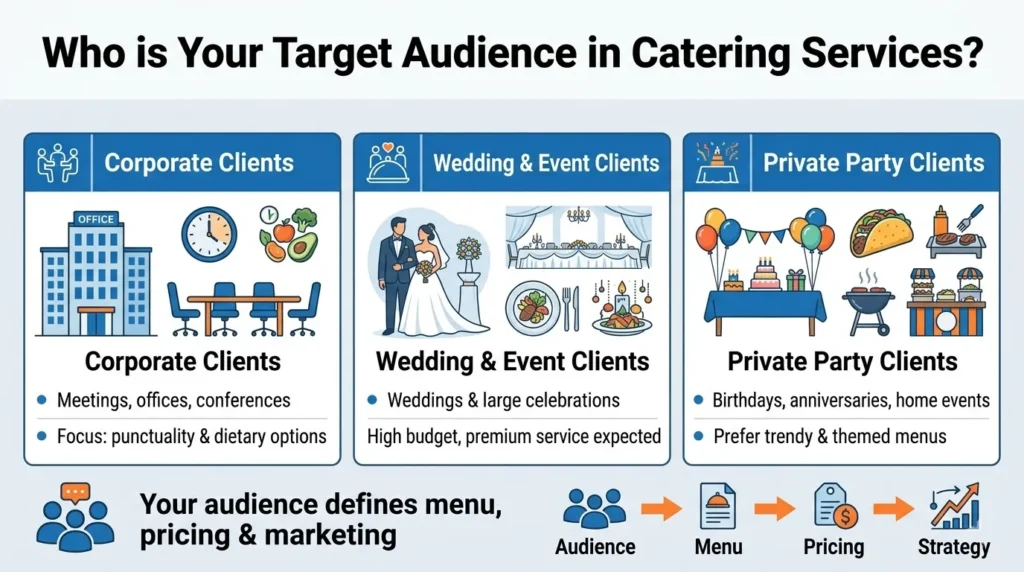
Who you serve determines your menu, marketing and pricing. The catering clients can be often identified in three definite groups in the U.S. market:
- Corporate Clients: Board meetings, conferences and offices. They are concerned with punctuality, dieting (gluten-free, vegan), and business appearance. They are usually repeat customers and they like to work during the day.
- Wedding and Event Clients: Wedding, groom, and event planners. This group has a bigger budget and expects perfection, intricate tastings, and high-service.
- Private Party Clients: Birthdays, anniversaries, and family reunions. These customers tend to prefer light, trendy or themed menus like taco bars, high-end BBQ buffets or interactive food stations.
Now that you have an idea of your ideal customer, you are now prepared to construct the operational foundation of your business.
How to Start a Catering Business: Start Ultimate Guide.
We have covered the key steps to start your catering business in order to simplify the process. These steps will ensure that you comply with all US regulations and reach important milestones by the time you put your first plate to the table.
Step 1: Determine Your Catering Niche.
Your specialty should be determined before you get down to cooking. Are you going to cater to corporate dinners and small wedding affairs, or do you plan on catering drop-offs at a BBQ party? The niche selection can assist you in targeting the appropriate customers, designing marketing, and developing a menu. Attempting to be everything to everybody will result in burnout; specialize early to be different.
Step 2: Prepare an elaborate Business Plan.
Whatever is happening, a business plan is your blueprint. It must encompass executive summary, market research, competitor research, marketing plan and financial estimates. A formal, well researched business plan is necessary in case you are seeking a small business loan in a US bank or credit union.
Step 3: Laws and Establishing the company.
In order to conduct business in the United States, you need to incorporate your business and obtain the proper documentation.
- Select a Business Structure: The majority of Business structures followed by the caterers in the US are Limited Liability Company (LLC). LLC shields your personal belongings (such as your house and savings) in case your company is sued.
- Get an EIN: Use a free application of Employer Identification Number (EIN) on the IRS site. This will be required to open a business bank account and paying taxes.
- Obtain Business Licenses: Obtain a general business license of your city / county. In case you intend to sell alcohol, then you have to request a local liquor license.
- Get Business Insurance: In the event industry, general liability insurance and commercial auto insurance (delivery vans) are necessary.
Step 4; Develop and Test Your Menu.
Your menu is the main product. Create great, transportable, and scalable dishes. You should test your recipes at least once, to maintain consistency, and keep track of the cost of each ingredient to use this for setting prices in the future.
Step 5: Hygiene Requirement and Food Safety Inspections.
Strict food safety laws are practiced in the US, through the local health departments. A single failure in inspection can bring your business to a tone.
- Food Handler Certification: You and your employees would need to undertake food safety certification. The most popular program in the US is ServSafe. You probably will require a Food Protection Manager on site when preparing.
- Health Department Inspections: The local health department will survey your kitchen, including refrigeration, and sanitization areas as well as cross -contamination procedures, before opening.
Step 6: Acquisition of Commercial Kitchen Space.
Most states in the US do not allow running a catering business in an ordinary kitchen due to the strict FDA regulations. You have to rent a business space, lease a common commissary kitchen, or construct your own facility in accordance with the local health standards.
Step 7: Catering Startup Costs and Finances.
The startup costs are very important to understand in order to prevent premature cash-flow issues. Startup costs will be vastly different depending on whether you rent a specific place or construct a kitchen on your own. Table of Estimated US Catering Startup Costs is mentioned below:
| Expense Category | Shared Commissary Kitchen Route | Private Commercial Kitchen Route |
| Kitchen Rent / Lease | $500 – $1,500 / month | $3,000 – $8,000 / month |
| Equipment & Supplies | $1,000 – $3,000 (pots, pans) | $20,000 – $50,000 (ovens, fridges) |
| Licenses, Permits, Insurance | $1,000 – $2,500 | $2,000 – $5,000 |
| Marketing & Website | $500 – $1,500 | $1,500 – $5,000 |
| Initial Food Inventory | $500 – $1,000 | $2,000 – $5,000 |
| Total Estimated Startup Cost | $3,500 – $9,500 | $28,500 – $73,000 |
Note: Hourly lease of a commissary kitchen is the least risky financial path that new US caterers can sustain for good cash flow.
Step 8: Develop your Network of Vendors.
Establish connections with wholesale food vendors (such as US Foods or Sysco), farmers in the area, as well as, equipment rental businesses. The success of a seamless catering process depends on credible suppliers.
Step 9: Setting the Catering Pricing
The price is too high and customers will go. The price is too low and you can make a loss. Use a simple cost‑plus method:
- What you do first is to compute the cost of all ingredients of a dish.
- The next thing to do is to add overhead, which includes kitchen rent, delivery insurance and gas.
- Include the number of hourly wages of prep cooks and waiters.
- Finally add a markup of about 300%. e.g. when you say a plate costs you 15 in food, labor and overhead, keep it at least at 45 to make a good profit.
Your business is in place now, your kitchen inspected, your prices established, so you are now nearly ready to begin. Long-term success does not only involve doing the right things, but also avoiding errors that occur most regularly. Make sure not to make these rookie mistakes before you book your first event.
If you’re exploring business opportunities, you might also consider alternatives like a storage unit business or even a vending machine business, both of which can offer semi-passive income models. However, unlike catering, these ventures lack the creative, service-driven, and customer interaction aspects that make the catering industry dynamic and rewarding.
Common Mistakes to Avoid When Starting a Catering Business
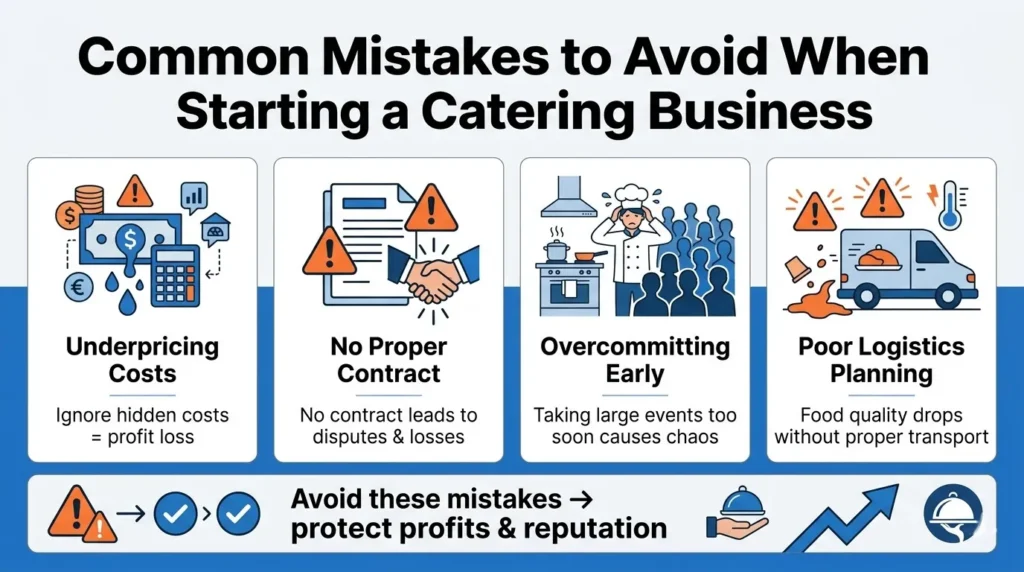
First-time caterers always get into easy traps, even with an excellent plan and incredible cooking skills. By not falling into these premature issues you can save your service and revenue.
- Under pricing and Ignoring Hidden Costs: This is the number one cause of failure of new caterers. It is simple to determine the price of chicken and veggies, but most novices overlook such costs that are not as visible: shopping, preparation time, transportation, vehicle maintenance, and cleanup. It is always advisable to employ a cost plus pricing strategy and appreciate your work.
- Working Without a Good Contract: A handshake agreement is dangerous. A client may include 20 additional guests on the eve, or will challenge the final bill without a formal contract. ALWAYS make sure to sign a contract, where the menu is provided, final headcount date, cancellation policy, and a non-refundable deposit schedule is given.
- Exceeding expectations on Event Size: A new operation can be exhausted by saying yes to a 300-person wedding in the first month. The logistics of cooking 30 people and cooking 300 people are different. Begin with small, get familiarised with your workflow and increase your maximum number of guests as your crew and equipment expands.
- Overlooking Transport and Logistics: A fantastic meal in the kitchen is just half the battle, it should remain good in a 45 minutes van. Failure to invest in appropriate holding equipment or a practice run of the trip can result in cold food, melting desserts or cracked plates.
By evading these traps, you save on your margins and your initial brand image. A perfect plan still requires you to check the reality in the industry.
Is Starting a Catering Business Worth It?
Many entrepreneurs would want to know whether a catering business is profitable today, before dedicating time and money to the business. The answer to this is yes, though this would depend on your model.
Profit margin in successful catering companies is 10-12 percent in the U.S., compared to 3 percent of profit margin found in the restaurant industry. These are the advantages and disadvantages that you should consider in order to determine whether it is the right option:
Pros of a Catering Business:
- High Profit Margins: The low level of waste and controlled inventory imply increased profits.
- Scalability: You can get part-time on rent with a rented kitchen and expand your home kitchen as the cash flow increases.
- Freedom to be creative: You do not have to be bound to a particular menu over the years because you have the freedom to continually be creative during particular events.
- Reliable Schedule: You only work when you have booked events, which provides improved planning compared to a 7-day restaurant.
Cons of a Catering Business:
- Stressful Setting: Weddings and big company meetings have no room for error.
- Physical Requirements: It can be tiresome to lift heavy weights, work long hours and work in hot kitchens.
- Tough Rules: The local health codes, insurance and certification renewal process require a bureaucratic approach.
- Seasonal Changes: Promotional revenue is high in the period of summer wedding but decreases in the winter.
Conclusion
Starting a catering business is beyond just cooking delicious food. We have discussed the most necessary steps in this guide, such as determining a niche, preparing a strong business plan, and testing your menu. We have also addressed more specific legal requirements such as creating an LLC, obtaining an EIN, passing food safety inspections, handling startup finances, and establishing profitable prices, and balanced out practical advantages and disadvantages.
Begin with a commissary kitchen and establish a strong vendor base and utilize focused marketing such as micro-event demos. In the emerging U.S. catering market, you can establish a sustainable and highly profitable business.
FAQs
1. Is It Possible To Begin A Catering Business At Home In The United States?
In most cases, no. FDA and local health regulations typically require a certified commercial kitchen for preparing food for the public. However, some states allow limited home-based operations under cottage food laws for low-risk items like baked goods. It’s important to check your specific state regulations before starting.
2. Which Catering Food Items Will Be The Most Profitable?
Plant-based and carbohydrate-rich meals tend to offer higher profit margins. Options like pasta bars, taco bars, wood-fired pizzas, and vegetarian curries are cost-effective to prepare while allowing for premium pricing when presented well.
3. What Is The Average Annual Earnings Of Owners Of Catering Businesses?
Small to mid-sized catering business owners in the U.S. typically earn between $40,000 and $80,000 annually in the early years. Established businesses with steady corporate contracts can generate over $150,000 per year.
4. Do I Require A Degree In Order To Begin Catering?
No, a culinary degree is not required. Strong business skills, organization, and proper food safety certifications (such as ServSafe) are more important for running a successful catering business.