
Starting a bookkeeping business is one of the smartest ways to turn financial skills into a steady, scalable income stream. With businesses of all sizes needing accurate records, expense tracking, and compliance support, the demand for reliable bookkeepers continues to grow. The best part? You don’t need a massive investment or a large team to get started, just the right knowledge, tools, and a clear plan.
Whether you’re a finance professional ready to go independent or someone looking to build a profitable service-based business from scratch, bookkeeping offers flexibility, recurring revenue, and long-term growth potential. From choosing your niche and setting up your services to pricing, software, and client acquisition, every step you take early on lays the foundation for success.
In this guide, we’ll walk you through exactly how to start a bookkeeping business from the ground up, covering the essential steps, practical tips, and strategies you need to launch confidently and grow sustainably.
What is a Bookkeeping Business?
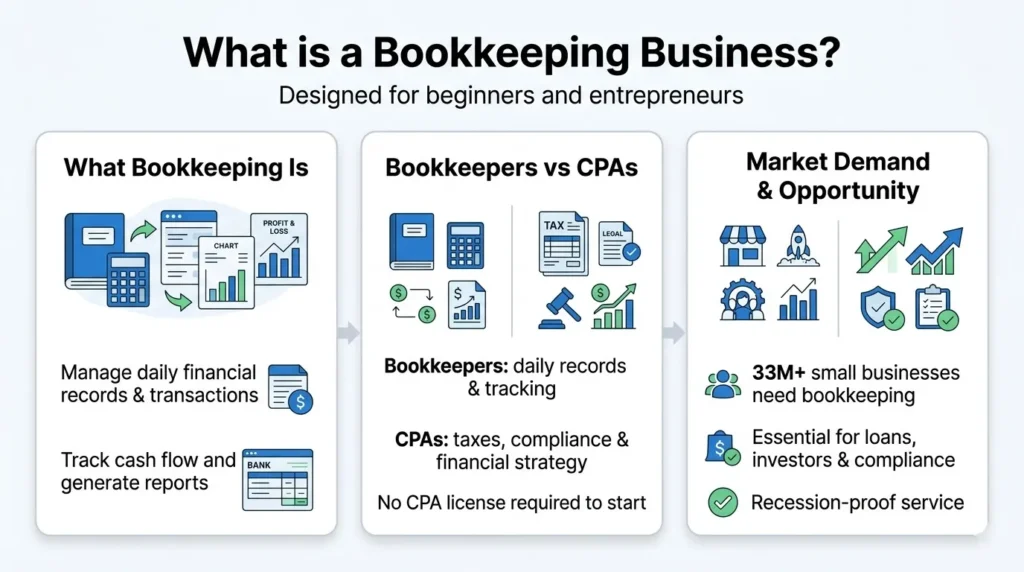
A bookkeeping business is your gateway into one of the most stable and in-demand service industries. At its core, it’s all about helping businesses stay financially organized and in control. From recording daily transactions and reconciling bank statements to preparing essential reports like profit and loss statements, bookkeepers ensure that every financial detail is accurate and up to date.
But it’s more than just number-crunching. A bookkeeping business plays a vital role in helping entrepreneurs understand their cash flow, make smarter decisions, and stay compliant with financial regulations. As businesses grow, so does the complexity of their finances—making professional bookkeeping not just helpful, but essential.
Bookkeepers vs. CPAs
Certified Public Accountants (CPAs) assist in elaborate tax plans and the filing with the IRS, whereas the bookkeepers maintain daily records. Bookkeeping does not require a license as a CPA does hence it is simple to begin.
The Massive US Market Demand
Demand of virtual bookkeepers will never disappear:
- Unlimited Supply of Clients: There are more than 33 million small businesses in the US, and the majority of the owners do not have time or the abilities to balance their books.
- Strong adherence: It is necessary to have accurate records to obtain SBA loans, attract investors, and remain IRS-compliant.
- Recession-Proof: The cash flow needs to be carefully tracked, even during slow economy periods, therefore, bookkeeping remains a necessity.
With the big market insight, now we are going to take a tour through the real steps of establishing your new business.
Explore more business options:
How to Start a Bookkeeping Business: Step-by-Step Guide
It takes planning and execution to begin a business out of an idea. This manual will give you easy steps to start a bookkeeping business.
Step 1: Determine Your Niche and Your Target Market.
Several beginner bookkeepers strive to help everybody. Select a target group to serve in order to specialize in their needs and set higher prices.
- Niche Industries: e-commerce, real estate, health care clinics, building, or display promotion agencies.
- Service Niches: Catch-up work: work with businesses staying months behind, or intense focus on payroll and inventory.
Specialization also means you become very good at doing that thing, and thus you become more valuable compared to being a generalist.
Step 2: Issue a Bookkeeping Business Plan.
A business plan is your pathway to profitability. It does not need to be long, just address these main points:
- Description of the Mission and primary objectives.
- Service Offerings: What you will and what you will not do for your clients.
- Financial Projections: Startup expenses, software, marketing and initial revenue year.
- Competitor Analysis: discover what another bookkeeper in your niche charges and/or offers.
Step 3: Determine Your Legal Business Organization.
Taxes and liability will depend on the legal form that you are going to use.
- Sole Proprietorship: The easiest, least expensive, but personal finances and business finances are not distinct. Your savings are in danger in case a client sues.
- Limited Liability Company (LLC): Best recommended. Renders protection of personal property, pass through tax provision, and business income retained in your personal return.
- Corporation: Good in case you intend to create a large-sized agency, and you will employ a lot of workers, yet it comes with more rules and may be subject to double taxation.
Step 4: Register your Business and receive an EIN.
Make your business official.
- Register in the State: Fill Articles of Organization and pay the fee.
- Register an EIN: Reserved at the IRS, request a free nine-digit number such as a Social-Security number number to identify your business online. You should have it in order to open a bank account.
- Check Local Licenses: Inquire with your city or county clerk whether you should have a local business license or not.
Step 5: Find the Right Business Insurance.
Bookkeeping carries risk. Insure yourself using the following policies:
- Errors and Omissions (E&O) Insurance: This type of insurance covers errors or failure of deadline that leads to loss of money by clients.
- Cyber Liability Insurance: This is used when confidential information is stolen or compromised.
- General Liability: This is the most basic since it covers simple accidents provided that you meet the clients at a real office.
Step 6: Choose Your Office Setup.
Decide between a physical office setup or virtual setup. Virtual offices save rent, utility and transport. All one needs is a proper laptop, a steady internet connection, and a comfortable place.
Step 7: Select the most appropriate Bookkeeping Software.
Choose cloud-based technology that will allow you and your customers to view records. Few such software are as follows:
| Software | Best For | Key Features |
| QuickBooks Online | General US small businesses | Deeply familiar to CPAs; massive app integration |
| Xero | Tech startups & E-commerce | Highly user friendly interface |
| Gusto / OnPay | Payroll management | Automated US tax withholding compliance |
Step 8: Establish the Business Infrastructure and Banking Accounts.
Automate repeated tasks.
- Business Bank Account: When dealing with business, it is good to maintain business money distinctly and personal money separately. Create a checking account in your EIN.
- Practice Management Software: When you need to control your practice, programs such as TaxDome or Financial Cents can come in handy as they allow you to manage different processes, request documents, and keep track of new deadlines.
- Secure File Sharing: Do not use unencrypted email. Access safe portals or gised cloud managed storage like Google Workspace or Dropbox Business.
Step 9: Marketing Your Bookkeeping Services.
Proper pricing leads to profitability.
- Hourly Pricing: This pricing is most popular amongst beginners and it may punish fast work.
- Fixed monthly retainer: There is a flat charge, independent of the work done (e.g. $500 a month), but it still has a limit by the length of the work. Provides foreseeable income on both ends.
- Value-Based Pricing: Bill on the economic clarity and economy you bring and not hours.
Step 10: Sell your business with digital marketing and SEO.
Clients need to find you.
- Create a search-engine-optimized Webpage: Spell out what you serve and how, focus on local search (e.g., bookkeeper in Austin, TX), and focus on niche search (e.g., bookkeeping stores are on Shopify).
- Content Marketing: Publish useful blog articles to different financial topics to gain authority and traffic.
- Google Business Profile: Claim and enhance it on local map searches.
- LinkedIn Networking: Show your specialization abilities, meet agency founders and the owners of small businesses who can refer.
Step 11: Onboard and Reach Your Clients.
Provide an effective onboarding process. Send official Engagement Letter clarification on scope, payment and confidentiality. Do routine communication such as the monthly call to provide financial review to clients to support and keep them at par.
It is a big victory to be legally established and technologically prepared. Long-term success implies demonstration of your competencies by means of credible work and professional qualifications.
What is The Cost of Starting The Bookkeeping Business?
When you divide the amount of money you require to start, it all depends on whether you work at home or in a rented office. Home offices are far cheaper in the sense that you do not pay rent and utility bills. Renting an actual office is more expensive in terms of renting a particular office, utilities and buying office furniture.
| Startup expense | Estimated Cost | Frequency |
| LLC Formation and Local Licenses | $50 – $500 | One-time |
| Hardware (Laptop, Scanner, Dual Monitors) | $500 – $1,500 | One-time |
| Office Furniture (Desk, Chairs, Filing Cabinets) | $0 (Home) – $1,000+ (Leased Office) | One-time |
| Office Space (Rent & Utilities) | $0 (Home) – $1,500+ | Monthly |
| Bookkeeping Software (QuickBooks/Xero) | $30 – $150 | Monthly |
| Insurance (E&O and General Liability) | $50 – $150 | Monthly |
| Marketing, Domain & Website | $50 – $500 | Monthly / Variable |
| Estimated Total to Launch | $680 (Home-based) to $5,300+ (Physical Office) | Initial Investment |
Note: In case you are planning to hire employees immediately or require a place of business to be refurbished to host a client, you will have to secure additional startup capital or a small business loan.
Top Certifications in Bookkeeping Business
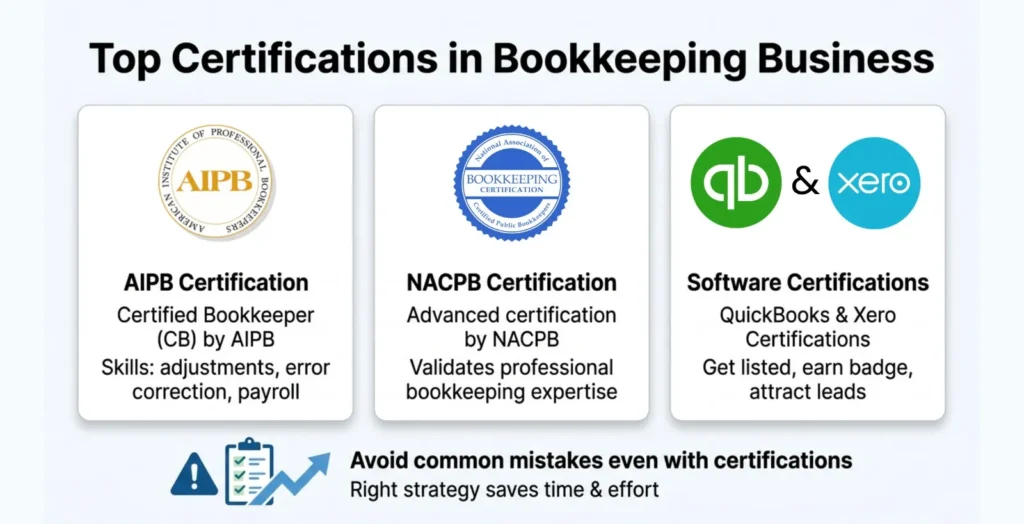
In the US government, there is no required degree or license as a CPA to bookkeep, but professional certifications may help build your reputation as a beginner:
- AIPB Certification: The American Institute of Professional Bookkeepers has a Certified Bookkeeper (CB) designation that indicates that you can make adjustments, correct mistakes and handle payroll.
- NACPB Certification: The National Association of Certified Public Bookkeepers provides challenging examinations to the formidable license of bookkeeping.
- Software Certifications: QuickBooks and Xero provide free programs on partnerships. Being a QuickBooks ProAdvisor or Xero Certified Advisor will get you a badge on your site and you will feature in their official directories, which provides you with free leads.
New entrepreneurs make many mistakes even with optimum setup and credentials. Being aware of the pitfalls to avoid, is time and stress-saving.
Common Challenges and How to Overcome Them
Operating a financial company is characterized with special challenges. Be ready for these:
- Scope Creep: A client can be paying basic monthly categories and he/she may then request complex cash flow projections, HR work, or personal tax service. They should establish clear rules in their Engagement Letter and levy a surcharge on the work that is not covered.
- Disorganized Clients: You will encounter some clients who confuse personal and business money or misplace receipts. Develop rigid procedures and install applications that allow them to take pictures with their mobile phone in order to capture the receipts.
- Imposter Syndrome: New business owners are prone to a belief that they are not capable enough to charge professional fees. Always remember your basic knowledge of financial organization is much better than that of the average overburdened owner.
Conclusion
The decision to open up a business is one of the most satisfying ones. In this blog, we have talked about how to begin a bookkeeping company. You are now ready to grow with the knowledge of the demand, LLC, the choice of cloud tools, and marketing plus use of SEO to attract clients. Accuracy, security and being a trusted financial advisor is the key to success. Find that first client and begin a profitable business today in one step at a time.
FAQs
1. Should I Be Licensed as a CPA in the US?
No. CPAs deal with complex tax initiatives and IRS returns, and bookkeepers are concerned with the day-to-day financial planning.
2. How Much Does it Cost to Start?
Initial expenses are minimal and range between $500 and $1,500. This includes the creation of LLC, liability insurance, web hosting, and first-time software subscriptions.
3. Would I Be Able to Run a Bookkeeping Business Entirely From Home?
Absolutely. Virtual bookkeeping is the most popular, efficient, and cost-effective because it allows bookkeeping in the cloud using cloud software such as QuickBooks Online and secure portals.
4. Is Bookkeeping Profitable?
Yes. Constant recurrent incomes and high profit margins are established with very low overheads and continuous monthly services.