
The Vending machine business is a booming entrepreneurship in India, which has become an appealing business venture among people who want to invest with a low start-up capital and low day-to-day management of the business. With the acceleration of urban life and the shift to purchases without contact and personal interaction, vending machines are becoming a smart retailing solution. Market estimates put the Indian vending machine market at a value of approximately USD$ 699.5 million (~₹5,800 crore), which is expected to increase gradually over the next decade due to the requirement in offices, hospitals, public transport centers, and corporate environments.
The consumers around the country are becoming more demanding when it comes to being able to access snacks, beverages, and various necessities without having to wait in a queue or make any contact. Vending machines will achieve this requirement by providing automated service 24/7, without the necessity of a traditional shop, employees, or long opening hours. The convenience is also increased with the use of modern smart machines with UPI, cards, and mobile wallet payments.
This business structure is most attractive to first-time entrepreneurs in India as it has a high potential of recurring income with easy management that leaves the owner to operate the vending business alongside other life obligations or other employers. A vending machine business can be a profitable venture of scale in case they are properly planned, has strategic placements, and carefully chosen products.
In this blog, we will guide you through the entire procedure of how to start a Vending Machine Business in India.
What is The Vending Machine Business?
A vending machine business is a type of automated retail business where the products are sold not by a physical store, by a machine. These machines are located in busy places like offices, hospitals, colleges, airports, metro station and other areas that are populated by people.
Customers also have an opportunity to order products online and pay automatically and get the item without a human touch. The new-fangled vending machines in India are UPI-supported, debit/credit cards, and mobile wallets, which are convenient and secure.
As the owner, what you need to do is to position the machine, stock products, keep the machine running and to trace purchases. The products to be sold can include snacks, beverages, fresh foods, hygiene goods, medicine, and even electronic accessories. This is a great business as a passive income that requires minimal operation since the machine will keep selling even at your absence.
Types of Vending Machines
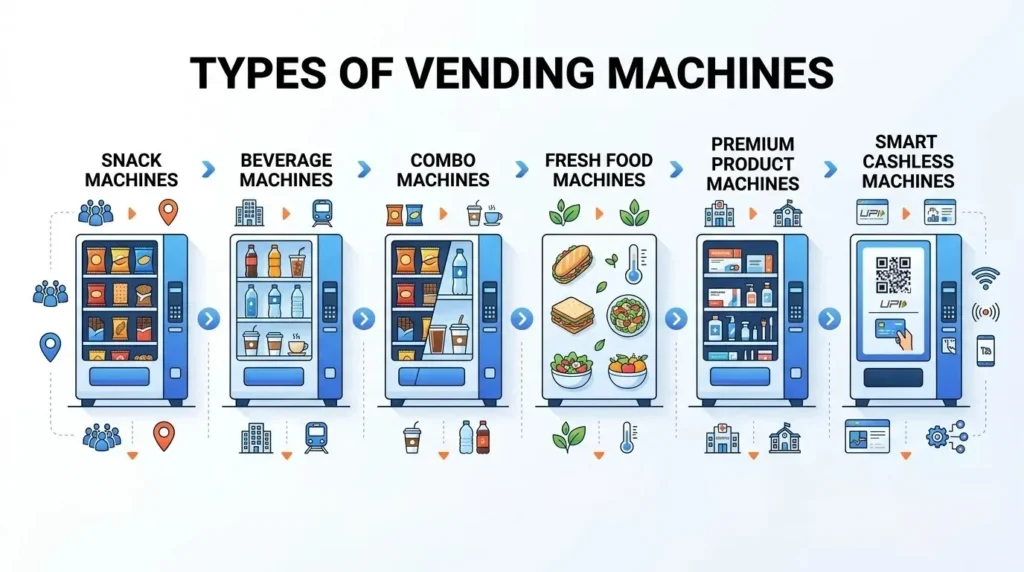
The first decision that needs to be made when initiating this business is the type of vending machine to choose. Products and locations have different machines. Knowing the options available will enable you to invest wisely and be able to satisfy the demand of the customers.
1. Snack Vending Machines
Snack vending machines are the most widespread and they are highly positioned in offices, schools, metro stations, and waiting rooms. They sell packaged foodstuffs like chips, biscuits, chocolates, and ready-to-eat foods. The machines are in the places where people would desire to have a quick bite like in high-footfall areas.
2. Beverage Vending Machines
Beverage vending machines are developed to be used in beverages like cold drinks, the water bottles, juices, and soft drinks. In some of the advanced models, there are also hot drinks such as tea and coffee. They are very much prevalent in corporate offices, hospitals, and railway stations.
3. Combo Vending Machines
The combination vending machines are those that sell snacks and drinks together. This renders them an economical option to areas that are characterized by different customer demands. The combo machines are best suited to malls, hostels, big offices and transport centers where customers would desire to have several choices.
4. Fresh Food Vending Machines
The sandwiches, salads, fruits, yogurt, or ready-made foods are sold on fresh food vending machines. They are temperature-controlled machines and are found primarily in airports, corporate campuses as well as high-end workplaces where individuals are finding healthier food options.
5. Premium Product Vending Machines.
These machines are tailored to certain products other than food and drinks. They are able to dispense hygiene products, medicine, stationery, phone accessories or even personal care necessities. In many instances, hospitals, colleges and other locations with multiple people on the move may have specialty vending machines installed.
6. Intelligent and Vending Cashless machines.
The current state of modern vending machines is also characterised by such smart technology features as UPI payments, card support, mobile wallets, remote monitoring, and sales tracking dashboards. The emergence of automation and digital payments is making these machines the choice in India.
Why Start a Vending Machine Business?
- Low-Cost Business Opportunity: The vending machines do not need the capital and rental outlets that are required of a shop or franchise.
- Less Work per Day: Machines require less work once installed since they require fewer refills and servicing.
- 24×7 Earnings Potential: Machines do not sleep and they continue to earn you even when you are sleeping.
- No Workforce Needed: There is no need to recruit employees, pay wages, or do any training.
- Simple Expansion: It is easy to add new machines in new locations without a significant increase in workload.
- Ideal to beginners: Low risk, simple management and applicable to first-time entrepreneurs or those who need a side income.
Also read: How to Start a Storage Unit Business
How to Start a Vending Machine Business: Step-by-step guide
Step 1: Market and Customer Demand Understanding.
One should analyse the market before investing even a single rupee. The success of a vending machine is not determined by its existence but by the fact that people require instant availability to products that are there.
Vending machines in India would also do best in places where people spend most of their time or require haste like offices, hospitals, colleges, and metro stations, gyms, and hostels. Such locations have consistent traffic and convenience-seeking customers.
The type of customer is also a factor of demand. Office employees can be interested in coffee, healthy snacks, or fast foods. Students tend to purchase snacks and soft drinks that are cheap. Hospitals are in need of water, juices, and hygiene requirements. Protein bars and health drinks are sought by gym users.
When you get to know the needs of the customer and the location, then you can select the products, price, and projected sales with more precision.
Key Points
- Examine foot moves and daily traffic.
- Find the proper location with match product demand.
- See what people buy in the surrounding area.
- Business risk is minimized through market knowledge.
Step 2: Choose what you are going to sell.
Your vending machine can only make money out of the machine. The selection of the products is further more important than that of the machine.
Begin by picking out things according to geographic requirements. Hospitals are more successful in water, juices, light snacks and hygiene products. Offices are known to go well with coffee, fast to eat foods, and fast foods. Protein based products are required in gyms.
When starting with such goods, it is recommended to start with popular and fast selling goods than expensive and unusual ones. Smaller packs will attract impulse customers. Categories can be extended with time on reviewing the sales performance.
Monitoring on a day-to-day basis can be used to determine the best selling products and clear stocks that are not moving fast to enhance profitability.
Key features
- Choose products depending on the type of location.
- Stoneset with cheap, trendy products.
- Demand of the test product prior to expansion.
- Review inventory according to the sales trends.
Step 3: Investment and Cost Structure Plan.
Right budgeting will avoid cash strains in the future. Vending machines are not as easy as they may sound.
The average price of a vending machine in India is ₹1.3 to 1.5 lakh rupees, depending on features. An additional charge of ₹5,000-10,000 can be added to installation, electrical setup and connectivity. Preliminary stock of the products can cost ₹10,000–₹20,000.
The initial price per machine will be approximately ₹1.5-1.7 lakh. The monthly costs are minimal, consisting of replenishment, electricity and occasional repairs. A good location means zero shop rent and salary. This is a step that assists in calculating affordability and payback period.
Key Points
- Set up cost is a fixed investment.
- The monthly operating expenses are very low.
- No employees or store rentals required.
- Budget determines size and rate of growth of business.
Step 4: Revenue and Profit Potential.
The income of the vending machine is based on place, price, and mix. Income is not deterministic but estimations are useful in planning. The usual prices of the products are between ₹25 and ₹50. One machine can sell 20-75 a day which will produce approximately ₹30,000-₹50, 000 per month. The recovery period of most machines is 12-18 months after which they will be long term profit assets at low running costs. Location selection is the biggest factor that influences profits.
Key features
- The earnings depend on the foot traffic and position.
- ROI increases following the cost recovery.
- Long-term profits are strong.
- Intelligent positioning drives sales.
Step 5: Select the appropriate Vending machine
Not all vending machines are the same. The right choice of model spares one trouble later.
Contemporary machines have to accept cashless transactions such as UPI and cards. Remote monitoring enables the monitoring of sales and stock without having to visit the stock on a daily basis. The use of energy efficient machines saves on electric bills and the robust nature of the constructions makes them last long.
Select the machines according to the type of product: snack machines, beverage machines, combo machines, or fresh-food machines. Big machines are more appropriate in the office and metro stations, whereas small machines are appropriate in the gym or hostel.
It is important to sell after sales. An inexpensive machine devoid of services can turn out to be expensive in the future.
Key features:
- Choose machines depending on product category.
- This must support the use of cashless payments.
- Remote monitoring is time saving.
- Support in terms of service and maintenance is important.
Step 6: Choose the most Appropriate Place
The most critical criteria in the success of vending is location. Even a perfect machine will not work when it is located where people do not make stops very often.
Vending is most effective in areas of impulse buying where individuals can see and use the machine easily. Ideally, offices, hospitals, colleges, metro stations, hostels, gyms and waiting areas can be used.
Location of areas should be visible close to entry points and corridors, cafeterias, and waiting rooms.
Location deals tend to be either fixed rent or revenue sharing. Amateurs would like revenue sharing as it minimizes risk. Estimating anticipated sales is always important when signing.
Key features
- Space size is less than the footfall.
- Direct availability fosters buying urgently.
- Select rental conditions according to the budget.
- Unstable revenue is attributed to poor location.
Step 7: Licenses and Compliance Requirements.
Legal operation prevents punishment and troubles in the future. In case food is to be sold or beverages sold, hygiene and safety have to be followed through registration by FSSAI.
GST registration can also be in case you intend to grow or deal with corporate clients. Some of these places might require municipal approval or that of property owners.
Machines are to be electrically safe and all products have to show expiry dates and ingredient labels. Different states have different regulations, and it is always necessary to check the state requirements.
Key features
- FSSAI is mandatory for food peddling.
- GST assists in scaling and company transactions.
- There should be hygiene and electrical safety.
- Avoiding problems in the future is achieved through legal compliance.
Step 8: Stock and Operations Management
A vending machine can only make profit when it is loaded and in good condition. Sales and dissatisfied consumers are lost when machines are empty or faulty.
First should be refilled with fast-moving products. Minimize wastage due to expiry using the FIFO technique. Do not stock slow-moving products in machines that hamper space and cash flow.
Frequent cleaning and technical inspections enhance the customer’s confidence. Remote dashboards are useful in testing sales, inventory, and machine well-being without having to visit the site on a daily basis.
Key Points
- Machinery will have to remain in operation and be replenished.
- Focus on high-demand items.
- FIFO reduces expiry losses.
- Customer loyalty is created by clean machines.
Step 9: Sales and Marketing Expansion
Most people feel that vending machines do not need to be marketed but advertisement is a significant factor in the sale.
First time users are offered launch discounts. Buy offers promote repeat business. Major products and offers can be marked by means of simple stickers or signage.
The tracking of sales assists in determining the most selling locations and products. When effective strategies have been tried and proved, then you can replicate them to other locations.
Additional revenue can also be earned in brand associations and sponsored product placements.
Key features
- First-time buyers are attracted by promotions.
- Bundling enhances mean order value.
- The use of sales data allows in performance optimization.
- The partnerships with brands generate new sources of revenue.
Step 10: Scaling the Business
One of the simplest businesses to expand is the vending machine businesses. After making one machine profitable, there is no need to have more machines without involving more staff and day to day effort.
With modern vending machines, one can easily monitor a range of machines in other cities or states because it is easy to operate multiple machines on a single dashboard.
Expansion is inexpensive as your shops and staff are not required, so that the use of vending machines is a tremendously scalable business model.
Key features
- Grow without recruiting additional employees.
- There are central dashboards that make work easier.
- The multi-city development is controllable.
- Scalability with minimal effort.
Guidelines to Manage Your Vending Machine Business
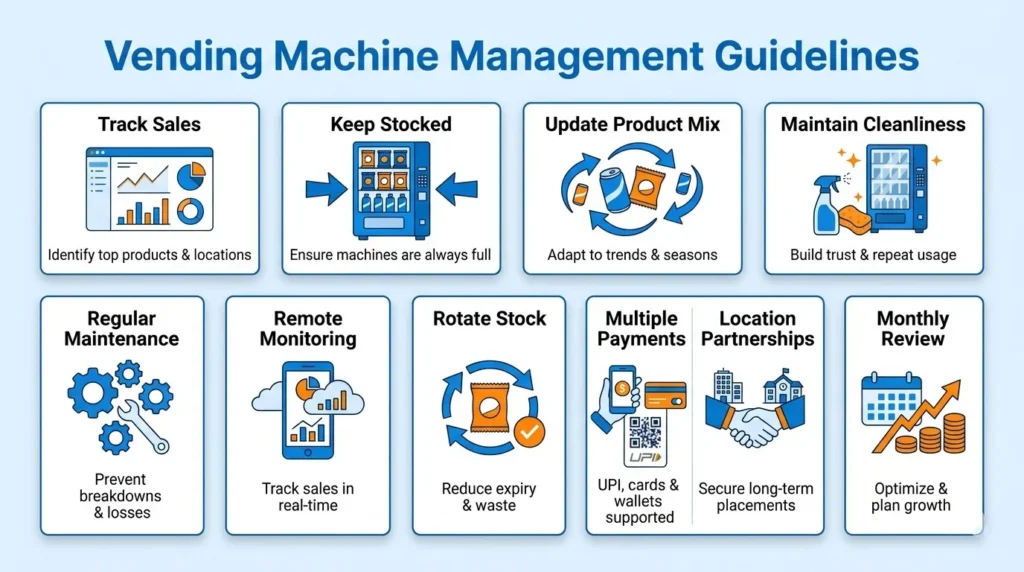
- Track sales on a regular basis to know the most successful products and places.
- Stock machines so that customers can find something every time.
- Change product mix depending on seasons and customer tastes.
- Keep it clean so as to create trust and repeat use.
- Perform periodic maintenance in order to avoid losses due to breakdowns.
- Real-time live monitoring with remote monitoring tools.
- Turnover of stock that moves slowly should be rotated in order to reduce waste due to expiry.
- Provide a variety of payment facilities such as UPI, cards, and wallets.
- Establish good working relations with property owners to get long term placements.
- Conduct a performance review after every month in order to plan improvements and expansion.
Common Mistakes to Avoid
- Poor Location Selection: Low pedestrian zones will result in low sales despite quality of products.
- Lack of Product Diversity: The same or dull stock lowers customer interest in the long run.
- Neglecting Maintenance: Unclean or malfunctioning machines are swiftly unpopular with customers.
- Failing to Track Sales Data: You will never be able to optimize inventory and refill schedules without data.
- Excessive Purchasing prematurely: Overbuying machines before the demand is known can waste capital.
Benefits of Vending Machine Business.
- Low Investment with High ROI: The cost of starting the business is lower than that of most businesses, and the prospects of high long-term earnings are high.
- Low Level of effort: Machines are automated and need to be occasionally refilled.
- Long-term Profitability: Machines can bring income many years after the recovery of the initial cost.
- Vast Product Diversification: You are able to sell foodstuffs, drinks, medicines, hygiene, etc.
- Be Your Own Boss: It does not need any supervising staff or day-to-day shop management, which means that it is an ideal venture to use part-time.
Conclusion
The vending machine business is a good and timely idea to start in India. Vending machines are gaining momentum as single-hand shopping and touchless shopping are increasingly sought after.
Through good planning, a good site selection, investing in good machines, and stock control, this business may offer a steady and scalable income.
A vending machine business is a good place to begin today, should you be interested in having a low-risk venture, passive earning potential, and long term growth. This guide has all the elements you should start and become successful in running a vending machine business in India.
FAQs
1. What is The Investment Required to Start a Vending Machine Business?
The initial investment for a vending machine business in India typically ranges between ₹1.5 lakh to ₹1.7 lakh per machine, including setup and initial stock. Costs may vary depending on the machine type, product selection, and location.
2. Is a Vending Machine Business Profitable in India?
Yes, a vending machine business can be highly profitable in India. With the right location and product mix, most machines recover their investment within 12 to 18 months, generating steady passive income thereafter.
3. Are Licenses Required for Vending Machines in India?
Yes, certain licenses are required. If you are selling food or beverages, FSSAI registration is mandatory. Additionally, GST registration may be required as your business scales or depending on your annual turnover.
4. Can I Run a Vending Machine Business Part-Time?
Absolutely. Vending machines operate automatically, making them an ideal option for part-time entrepreneurs or those looking for a passive income source with minimal daily involvement.
5. What Are The Most Profitable Products for Vending Machines?
Profitable vending machine products include ready-to-eat foods, packaged snacks, beverages, and healthy options. The best-performing products depend largely on the location, such as offices, schools, hospitals, or public spaces.